Growth insights
Reach Customers Who Are Ready to Buy Right Where They Search


Reach Customers Who Are Ready to Buy Right Where They Search
Data-led optimization that improves visibility across search engines, maps, and AI platforms—helping your brand get discovered where intent starts.
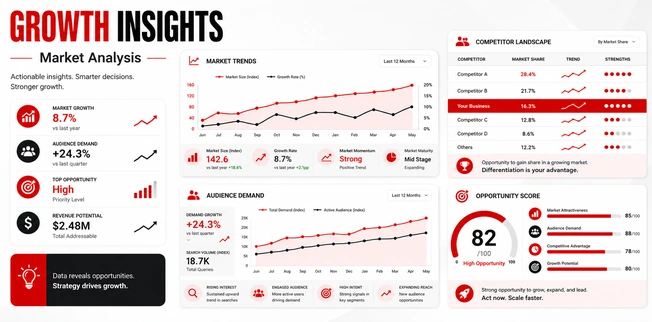
Market analysis reveals customer needs, competitor strengths, industry trends, and growth opportunities. It helps businesses make informed decisions, reduce risk, improve positioning, and create strategies that attract profitable customers.
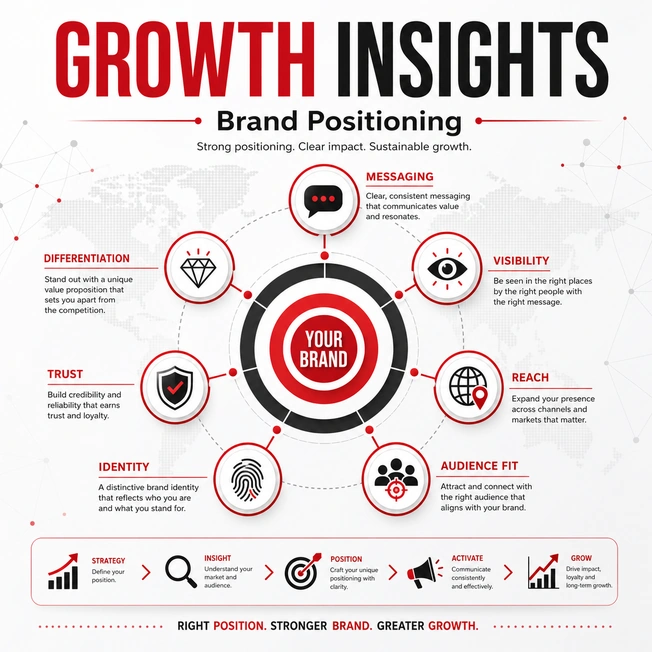
Brand positioning defines how customers perceive your business in the marketplace. Clear differentiation, messaging, values, and audience alignment build recognition, trust, loyalty, and stronger competitive advantage online.
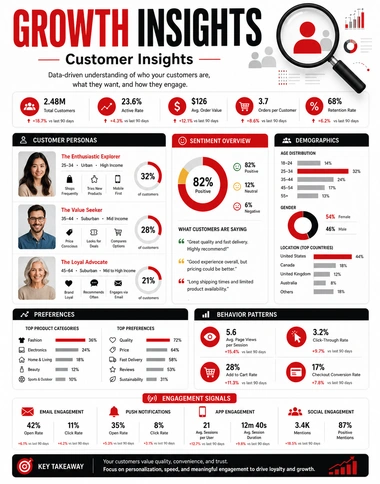
Customer insights reveal audience needs, behaviors, preferences, and pain points. Understanding this data helps businesses personalize messaging, improve experiences, strengthen relationships, increase engagement, and create smarter growth strategies.
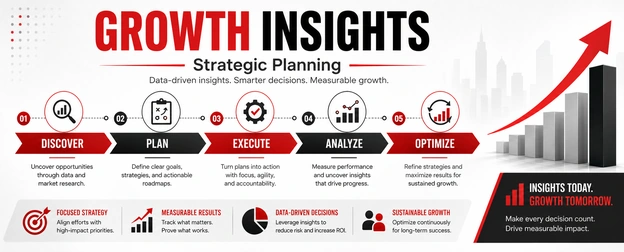
Strategic planning turns business goals into focused action. It defines priorities, aligns teams, manages resources, measures progress, reduces uncertainty, and creates a clear roadmap for sustainable growth and stronger decisions.
Growth insights reveal patterns, opportunities, and performance trends that guide smarter decisions, improve strategy, increase engagement, and support sustainable business growth.
Topic | Thought |
|---|---|
Industry Trends | Monitor market changes to uncover opportunities, threats, and customer demand. |
Competitor Research | Study rivals to compare pricing, messaging, visibility, and service strengths. |
Customer Demand | Analyze buyer interest to identify profitable products, services, and markets. |
Market Segmentation | Group audiences by needs, behaviors, budgets, locations, and buying triggers. |
Pricing Insights | Compare pricing patterns to find value gaps and competitive advantages. |
Audience Research | Understand customer profiles to create sharper marketing and sales strategies. |
Market Size | Estimate available demand to guide investments, goals, and expansion decisions. |
Competitive Gaps | Find underserved needs competitors miss and turn them into opportunities. |
Buyer Behavior | Track purchasing patterns to improve offers, timing, and customer experience. |
Growth Forecasting | Use performance trends to project demand, revenue, and expansion opportunities. |
Topic | Thought |
|---|---|
Unique Value | Define what makes your brand different, relevant, and worth choosing. |
Brand Promise | Communicate the main benefit customers can expect from your business. |
Messaging Framework | Create consistent language explaining value across every customer-facing marketing channel. |
Audience Alignment | Match brand messaging with customer needs, goals, and buying triggers. |
Differentiation Strategy | Highlight clear advantages separating your business from direct local competitors. |
Brand Voice | Develop a recognizable tone that builds trust and emotional connection. |
Market Perception | Understand how customers view your brand compared with competing alternatives. |
Positioning Statement | Summarize who you serve, what you offer, and why clearly. |
Emotional Benefits | Connect services to feelings customers value during important buying decisions. |
Brand Consistency | Maintain uniform visuals, messages, and experiences across customer touchpoints. |
Topic | Thought |
|---|---|
Customer Personas | Build profiles representing audience goals, challenges, preferences, and buying behavior. |
Pain Points | Identify customer frustrations that your products or services can solve. |
Purchase Motivations | Understand why customers buy to improve messaging and offer relevance. |
Behavior Tracking | Study actions across channels to reveal interest, hesitation, and intent. |
Feedback Analysis | Use reviews and surveys to uncover practical customer improvement opportunities. |
Audience Segments | Separate customers by shared traits to personalize marketing more effectively. |
Journey Mapping | Visualize customer steps to identify confusion, needs, and conversion barriers. |
Sentiment Trends | Monitor opinions to understand satisfaction, loyalty, complaints, and brand perception. |
Retention Drivers | Find reasons customers return and strengthen experiences that build loyalty. |
Conversion Intent | Recognize signals showing when customers are ready to take action. |
Topic | Thought |
|---|---|
Goal Setting | Define measurable objectives that guide priorities, resources, and team execution. |
Action Roadmap | Create step-by-step plans turning strategy into measurable business progress. |
Resource Allocation | Assign budgets, people, and tools where they create strongest impact. |
Risk Planning | Prepare for obstacles before they disrupt growth, timelines, or performance. |
Priority Mapping | Rank initiatives by value, urgency, effort, and business impact clearly. |
Growth Objectives | Set targets aligning marketing, sales, operations, and leadership focus. |
Execution Timeline | Schedule milestones to keep teams accountable and projects moving forward. |
Performance Reviews | Evaluate results regularly to adjust strategy and improve future decisions. |
Decision Framework | Use clear criteria to make faster, smarter, consistent business choices. |
Long-Term Vision | Clarify future direction so every action supports sustainable business growth. |
RedTalkers Digital Marketing Intelligence represents smarter decision-making through research, analytics, competitor insights, and customer behavior data. This picture should communicate strategy, technology, and business clarity. It shows how intelligent marketing systems can uncover opportunities, improve campaigns, guide content choices, and help brands compete more effectively in crowded online markets.









Hello@marketer.com
2912 Meadowbrook Road, Los Angeles, CA 90017